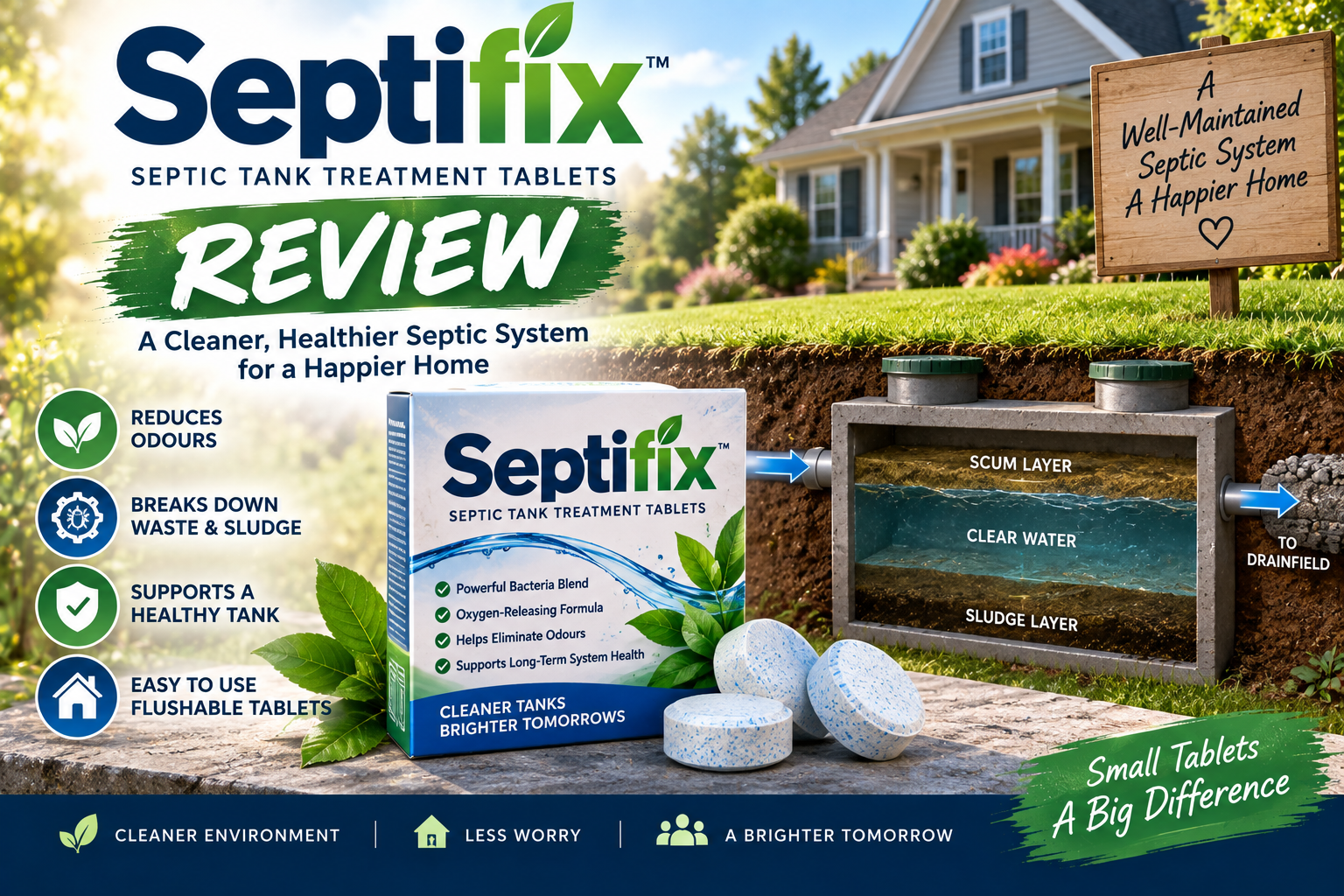
A well-maintained septic system is easy to forget about—until an unpleasant smell, slow drain or unexpected repair bill brings it to your attention.
Septifix is marketed to homeowners who want a simple way to care for their septic tanks. Its distinctive selling point is a flushable tablet containing bacteria and oxygen-releasing compounds, with the seller claiming that regular use can reduce odours, break down sludge and minimise maintenance costs.
It’s an appealing concept for people who prefer convenient, low-mess home-maintenance products.
However, the distinction between supporting routine care and replacing essential septic maintenance is crucial. The US Environmental Protection Agency (EPA) does not recommend septic additives for domestic wastewater systems and says they cannot replace professional assessment or periodic pumping.
This Septifix review explores the product’s advertised features, formula, instructions, current pricing and refund policy, as well as the practical considerations every homeowner should understand before ordering.
What Is Septifix?
Septifix is a septic tank treatment sold in tablet form.
According to the manufacturer, each tablet contains a blend of aerobic bacteria, oxygen-releasing ingredients and pH-regulating compounds intended to act on organic waste inside a septic tank.
The main attraction is convenience. Rather than opening the tank or mixing a treatment, the instructions tell users to place tablets in a toilet and flush.
The manufacturer promotes Septifix for several common concerns, including septic odours, organic sludge, grease buildup and the desire to reduce maintenance expenses.
Those are advertised uses, not independently established results.
Septifix at a glance
| Feature | Published product information |
|---|---|
| Product | Septifix septic tank treatment tablets |
| Format | Solid, flushable tablets |
| Tablet weight | 55 grams, according to the seller |
| Advertised formula | 14 aerobic bacterial strains, oxygenation and pH-regulating compounds |
| Application | Flush tablets down a toilet |
| Routine | Typically one tablet per month after an initial treatment, subject to the seller’s instructions |
| Supply options | Six, 12 and 18 months |
| Advertised refund | 60 days |
The manufacturer provides the formulation, usage and package details on the supplied website. I haven’t independently tested the tablets or verified the stated bacterial counts.
How Does Septifix Work?

The seller describes a three-part process involving oxygen, pH regulation and bacteria.
1. The Tablet Dissolves in the Tank
After being flushed, the tablet is intended to travel through the household plumbing and dissolve inside the septic tank.
The manufacturer says it releases sodium carbonate and oxygen, claiming up to 10 litres of oxygen per tablet.
That oxygen-output figure has not been independently verified here.
2. Oxygen and pH-Regulating Compounds Are Released
The product’s marketing says oxygen disperses through the tank while sodium carbonate helps buffer the wastewater’s pH.
It also claims this process can address the compounds responsible for unpleasant smells.
These are descriptions of the intended chemical action, not proof that the product will resolve the cause of an odour in a particular system.
3. Added Bacteria Act on Organic Material
Septifix is advertised as containing 14 strains of aerobic bacteria intended to break down organic matter, including toilet paper, oils, grease and other residues.
Microorganisms naturally play an essential role in wastewater treatment. However, a properly functioning septic tank already contains substantial microbial populations. The EPA says adding commercial bacteria is unnecessary for ordinary domestic septic systems and may sometimes cause harm.
The existence of a plausible ingredient mechanism therefore does not establish that Septifix improves real-world performance.
Septifix Ingredients: What’s Inside the Tablets?
The supplied website identifies three main ingredient categories.
Aerobic Bacteria
The seller reports 14 bacterial strains and more than 10 billion bacteria per gram.
The exact strains, independent potency testing and viability under different storage conditions weren’t established in the material I reviewed.
Oxygen-Releasing Compounds
The formula is designed to release oxygen after the tablet dissolves.
The seller associates this with odour reduction and increased bacterial activity.
Sodium Carbonate and pH Regulators
Sodium carbonate is identified as a buffering ingredient intended to influence wastewater pH.
The website describes the product as non-toxic and environmentally safe, but I couldn’t verify those broad safety claims through independent product-specific testing.
Before introducing any additive into a septic system, check its compatibility with your system and applicable local requirements.
How to Use Septifix Tablets
The manufacturer’s instructions describe an initial treatment followed by regular monthly use.
Initial Treatment
The sales page includes customer examples involving three tablets at the start of treatment. The appropriate quantity may depend on tank size and the product’s detailed instructions.
Do not assume that three tablets are suitable for every system. Follow the current packaging directions and seek professional advice if you’re unsure.
Monthly Maintenance
The website commonly describes one tablet per month after the initial application.
The simple application is a practical feature of the product’s design, although ease of use should not be mistaken for evidence of effectiveness.
Important Safety Precautions
Never enter a septic tank or lean into an open tank to inspect it. Septic tanks can contain dangerous gases and present serious hazards.
If wastewater is backing up, sewage is surfacing in the garden or persistent odours are present, contact a qualified septic professional rather than relying on tablets to correct the problem. The EPA recommends professional assessment for operational issues.
Does Septifix Really Work?
This is the most important question in the review.
Septifix’s website presents testimonials describing reduced smells, less visible sludge and fewer pumping visits. It also claims that odours may disappear within three to five days.
These are the seller’s claims and selected customer accounts. I couldn’t find independent, product-specific controlled testing establishing the advertised results.
More importantly, the EPA’s 2024 septic tank additives fact sheet advises against bacterial and chemical additives for domestic wastewater treatment. It explains that septic systems already contain microorganisms and that additives may be ineffective or negatively affect system performance and the environment.
That doesn’t establish what will happen in every individual tank, but it means the product’s broad promises shouldn’t be treated as proven.
Can Septifix Eliminate Septic Odours?
The seller claims its tablets can eliminate smells within three to five days.
An odour might arise from several different causes, including plumbing ventilation problems, a full tank or a malfunctioning drainfield. A tablet cannot be assumed to diagnose or correct those issues.
Persistent septic smells warrant investigation by a professional.
Can Septifix Break Down Sludge?
The product is marketed as accelerating the breakdown of organic waste.
However, septic tanks retain material that must be removed periodically. The EPA states that additives do not eliminate the need for pumping.
Can Septifix Prevent Clogs and Backups?
The website claims it can help prevent blockages and backups.
There is no independently verified evidence that Septifix can resolve structural damage, blocked pipes, drainfield failure or other mechanical problems.
If sewage is backing up into the home, treat it as a maintenance problem requiring prompt professional attention.
Can Septifix Save Money on Pumping?
The seller suggests that users may be able to reduce or even eliminate pumping expenses.
Do not skip scheduled inspections or pumping because you’re using Septifix.
The EPA recommends that typical household septic systems be inspected at least every three years and that tanks generally be pumped every three to five years, with the actual schedule determined by household size, tank capacity and usage.
Septifix Price: How Much Does It Cost?
The supplied website currently advertises three packages, with lower per-box prices for larger orders.
Advertised US website pricing
Choose a Septifix package
STARTER PACKAGE
6-month supply
$69
$69 per box, plus shipping
Advertised largest package
18-month supply
$147
Three boxes at $49 each; free shipping advertised
MID-SIZE PACKAGE
12-month supply
$118
Two boxes at $59 each; free shipping advertised
These are the prices shown on Septifix when reviewed. Confirm the total, currency, delivery destination and any applicable charges at checkout.
The seller also displays a higher reference price of $99 per box. I haven’t independently verified that as a previous selling price.
Buying a larger package reduces the advertised unit price, but it also means committing more money to a product whose performance hasn’t been independently established.
Does Septifix Have a Money-Back Guarantee?
The supplied website advertises a 60-day, 100% money-back guarantee.
It directs customers to contact the seller through links on the website if they’re dissatisfied.
I haven’t tested the refund process.
Before purchasing, check when the 60-day period begins, whether return shipping is required and whether shipping costs are refundable. Save the purchase confirmation and the policy displayed at checkout.
Septifix Pros and Cons
| Potential attractions | Important limitations |
|---|---|
| Convenient flushable tablet format | EPA does not recommend septic additives for routine domestic treatment |
| Formula and intended mechanism described | No independent product-specific efficacy testing established |
| Multiple supply sizes | Larger packages require a greater upfront spend |
| Monthly routine is easy to understand | Tablets cannot replace inspection or pumping |
| Seller advertises a 60-day guarantee | Refund process not personally tested |
| No need to open the tank to apply tablets | Serious septic problems still require professional attention |
The product features come from Septifix’s website; the maintenance concerns reflect EPA guidance.
Who Might Be Interested in Septifix?
Septifix is marketed to homeowners with private septic tanks who are interested in a convenient, tablet-based treatment.
Its straightforward application and multiple supply options may catch the attention of people comparing septic-care products.
However, anyone considering it should first establish whether their system actually needs an additive. According to the EPA, ordinary domestic septic systems generally do not.
If you’re experiencing a specific problem, professional diagnosis is a more reliable starting point than purchasing an additive based on symptoms alone.
What Actually Helps Maintain a Septic System?

Whether or not you’re considering Septifix, established septic-care practices remain essential.
The EPA identifies four central elements of septic maintenance:
- Inspect and pump the system as required.
- Use water efficiently to avoid overloading the tank.
- Dispose of waste properly rather than flushing unsuitable materials.
- Protect the drainfield from damage and excessive water.
These measures address the system’s operation directly and should form the foundation of any maintenance plan.
Frequently Asked Questions About Septifix
What is Septifix?
Septifix is a flushable septic tank treatment tablet containing advertised bacterial, oxygen-releasing and pH-regulating ingredients.
How often should I use Septifix?
The seller generally describes an initial application followed by one tablet monthly. Follow the current label and confirm suitability with a septic professional before introducing an additive.
Does Septifix eliminate the need for pumping?
No reliable evidence establishes that it does. The EPA says additives cannot replace periodic pumping.
Does Septifix remove septic smells?
The seller claims odour reduction within three to five days, but I couldn’t verify that claim independently. Persistent smells should be professionally investigated.
Is Septifix safe for every septic tank?
The seller describes the formula as safe, but I couldn’t verify universal compatibility. Septic designs and local requirements differ, and the EPA advises caution with additives.
How much does Septifix cost?
The supplied website advertises $69 for a six-month package, $118 for 12 months and $147 for 18 months. Shipping terms vary by package.
Is Septifix available in the UK?
The supplied website markets the product primarily to US homeowners. I couldn’t confirm UK delivery or suitability for UK-specific system requirements. Check the destination and product details before ordering.
Does Septifix offer a refund?
The seller advertises a 60-day money-back guarantee. Verify the full conditions at checkout.
Final Verdict: What Should You Know Before Buying Septifix?
Septifix offers a convenient product format and an interesting advertised combination of bacteria, oxygen-releasing compounds and pH regulators.
Its simple flush-and-use application is easy to understand, and the website provides several package sizes alongside a 60-day refund promise.
However, the strongest claims—particularly that Septifix can eliminate pumping, prevent all septic problems or reliably save hundreds of dollars—are not independently established.
The EPA’s guidance is also clear: septic additives aren’t recommended for routine domestic wastewater treatment, and professional inspection and periodic pumping remain necessary.
For homeowners interested in the product, the sensible next step is to verify whether an additive is appropriate for their particular system, then review the seller’s ingredients, package details and purchase terms.
Leave a Reply
You must be logged in to post a comment.