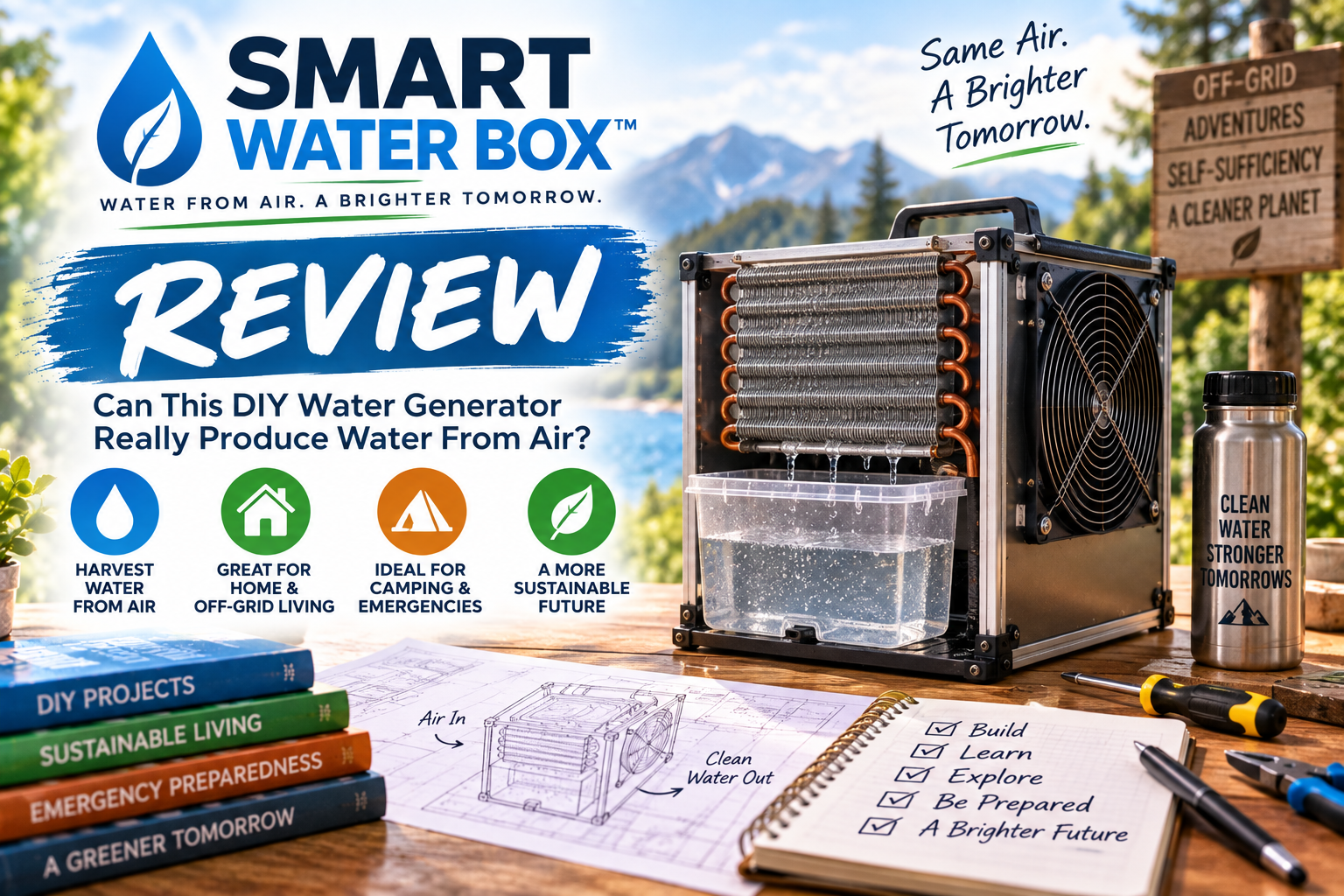
Imagine collecting water directly from the air around you.
For anyone interested in DIY projects, sustainable living, emergency preparedness or becoming more self-sufficient, it’s a fascinating prospect.
Most of us rely on mains water, wells or bottled water for our everyday needs. But the atmosphere contains water vapour, and under suitable conditions, that moisture can be collected.
The Smart Water Box is a digital DIY guide that promises to show readers how to build a compact water harvesting device capable of extracting moisture from the surrounding air.
Its website promotes a portable system for home use, camping and emergency situations, with the possibility of reducing water bills.
But how does it work? Is it suitable for beginners? Can it produce enough water for everyday use? And what should you know before purchasing?
Let’s explore the product in detail.
What Is Smart Water Box?
Smart Water Box is an instructional product designed to help readers construct a homemade atmospheric water generator.
The seller describes it as a step-by-step guide to building a portable water collection system.
It is marketed around several attractive ideas:
- Creating an alternative water supply at home.
- Harvesting moisture from the air.
- Exploring off-grid water generation.
- Preparing for emergencies.
- Reducing dependence on bottled water.
- Potentially lowering household water costs.
The website also claims the proposed device is compact, portable and relatively easy to build.
An important distinction is that the purchase provides information and instructions, not a fully assembled water generator.
You will need to obtain the necessary components and undertake the construction yourself.
How Does Smart Water Box Work?

Smart Water Box uses the concept of atmospheric water generation.
This technology is based on a genuine scientific principle: water vapour in the air can be condensed into liquid water.
You’ve probably seen condensation forming on a cold drink during a warm summer day.
The droplets appearing on the outside of the glass originate from moisture in the surrounding air.
A condensation-based atmospheric water generator applies a similar principle.
Step 1: Capture Moisture From the Air
A typical system moves surrounding air across a cooled surface.
The quantity of available moisture depends on the temperature and humidity.
Warm, humid air generally offers more favourable conditions for collecting water than cold, dry air.
Step 2: Cool the Air
When air is cooled below its dew point, some of its water vapour condenses into droplets.
The cooling process requires energy, which is an important consideration when calculating operating costs.
Step 3: Collect the Water
The droplets are directed into a collection container.
The efficiency of this process depends on the design, cooling capacity, airflow and environmental conditions.
Step 4: Treat the Collected Water
Condensed water isn’t automatically suitable for drinking.
Water can become contaminated through airborne particles, cooling surfaces, tubing and storage containers.
Properly designed treatment and testing are essential before using it as drinking water.
The science of condensation is well established, but Smart Water Box’s specific performance claims still require independent verification.
What Makes Smart Water Box Interesting?
The product’s appeal comes from combining a practical DIY project with the broader idea of water independence.
Here are some of its most distinctive advertised features.

Compact design
The seller promotes a portable system intended for use in different locations.

DIY construction
The product provides instructions for readers who want to assemble the device themselves.

Off-grid applications
The website promotes the concept for camping, travel and locations without conventional water connections.

Water harvesting
The project introduces the science of extracting moisture from the atmosphere.

Potential savings
The seller suggests the system could help reduce water-related expenses, although no verified savings figures are provided.
Features are based on the official Smart Water Box sales page.
What’s Included in the Smart Water Box Package?
The product is advertised as a digital instructional guide.
The official website describes step-by-step building instructions and three additional bonuses.
Main DIY Water Generator Guide
The core product explains the proposed method for creating a homemade water collection device.
Its purpose is to guide readers through the construction process.
However, I haven’t examined the complete purchased guide, so I cannot verify the accuracy of its diagrams or the completeness of its instructions.
Three Additional Bonuses
The official sales page advertises three free bonuses with the main product.
The accessible page text does not identify their titles or provide enough detail to assess their contents.
Before purchasing, check exactly what these bonuses include.
Digital Access
Smart Water Box is an information product rather than a physical appliance.
This means the building materials must be purchased separately.
Can Smart Water Box Produce Water in Any Climate?

The official website claims that the system can collect water in a wide variety of climates, including dry environments.
This is an appealing claim, particularly for people interested in emergency preparedness.
However, atmospheric water generation is strongly influenced by environmental conditions.
Humid Climates
Warm, humid environments contain relatively large quantities of water vapour.
These conditions can make condensation-based collection more productive.
Dry Climates
Dry air contains less available moisture.
Extracting useful quantities of water may require more energy or more specialised equipment.
Cold Climates
Cold air generally contains less water vapour than warm air at the same relative humidity.
This can limit the quantity of water available for collection.
The important point: A device that works under one set of environmental conditions may perform very differently elsewhere.
Without independently verified testing across different temperatures and humidity levels, the Smart Water Box’s climate-related claims remain uncertain.
How Much Water Can Smart Water Box Generate?
The quantity of water produced is one of the most important considerations for prospective buyers.
The official website uses language suggesting that users could establish an ongoing water supply.
However, it does not provide independently verified performance tables showing output under specified conditions.
To establish reliable performance, testing would need to measure:
- Ambient temperature and relative humidity.
- Electrical energy consumed.
- Water collected over a defined period.
- Water quality after collection and treatment.
- Equipment performance over extended operation.
Without these measurements, it is impossible to determine whether the proposed system can meet a household’s needs.
Is Smart Water Box Water Safe to Drink?
This is the most important safety question in the review.
The seller promotes the device as a way to obtain fresh water, but the website does not provide independent laboratory results establishing the quality of water produced by the proposed design.
Even if a device successfully collects condensation, that doesn’t automatically make the water potable.
Potential Contamination
Condensed water can pick up contaminants from the surrounding air and from components used in the device.
Possible concerns include microorganisms, metals and chemicals.
Suitable Materials
All surfaces contacting water intended for drinking should be suitable for potable-water applications.
Improvised or salvaged components may not meet this requirement.
Treatment and Testing
Appropriate water treatment depends on the contaminants present.
A qualified laboratory should assess the collected water against applicable drinking-water standards before it is used for drinking or cooking.
Do not rely on an untested homemade water generator as your sole drinking-water supply.
Is Smart Water Box a Good Hobby for DIY Enthusiasts?

One of the most interesting aspects of Smart Water Box is its potential educational appeal.
For people who enjoy building things, the science of atmospheric water generation provides an opportunity to explore several practical subjects.
Learn About Condensation and Humidity
The project introduces the relationship between temperature, moisture and the dew point.
These principles are relevant to air conditioning, refrigeration and environmental engineering.
Develop Practical Construction Skills
Studying a DIY design can help hobbyists practise reading instructions, identifying components and understanding how different parts of a system interact.
Explore Sustainable Technology
Atmospheric water generation raises interesting questions about water availability, energy efficiency and resource management.
Experiment With Measurements
A suitable educational project could involve measuring temperature, humidity and the quantity of condensation collected.
This can help demonstrate the difference between a functioning scientific experiment and a practical household appliance.
For beginners, low-voltage educational equipment is a more appropriate starting point than improvised mains-powered cooling systems.
Smart Water Box for Off-Grid Living and Emergency Preparedness
The product’s marketing highlights camping, emergencies and living away from conventional water infrastructure.
These are interesting applications for atmospheric water generation.
However, several practical considerations matter.
A condensation-based generator generally requires energy to operate.
If it depends on mains electricity, it may stop functioning during a power outage.
Its output will also depend on environmental conditions.
For genuine emergency preparedness, a dependable water plan should include established supplies, appropriate storage and proven treatment methods.
An experimental DIY device can be investigated as an additional project, but should not replace a reliable emergency water supply.
Can Smart Water Box Reduce Your Water Bills?
The website suggests that producing water at home could reduce utility bills and dependence on bottled water.
Whether this is financially realistic depends on several costs.
A complete calculation should include the price of the guide, building materials, electricity, maintenance, water treatment and testing.
For example, if a device consumes substantial electricity to collect a small quantity of water, the operating cost could outweigh any savings on mains water.
The relevant figure is the total cost per litre of safe, usable water.
No independently verified cost-per-litre data for the Smart Water Box design was available in the official materials reviewed.
Smart Water Box Price: How Much Does It Cost?
Advertised offer on related sales pages
Digital DIY guide
Approximately $39 USD
The exact price was not visible on the supplied website’s accessible page. Confirm the final amount at checkout.
Digital instructional product
Three bonuses advertised
60-day money-back guarantee advertised
Construction materials purchased separately
Related promotional pages display prices around $39, while the supplied website confirms the bonuses and refund offer.
What About Building Costs?
A related promotional website claims that the system can be assembled for less than $110.
This is a seller-side estimate, not an independently verified bill of materials.
Actual costs may include additional tools, replacement components, electricity, treatment equipment and water testing.
These expenses should be considered before beginning the project.
Does Smart Water Box Have a Money-Back Guarantee?
The official website advertises a 60-day money-back guarantee.
It states that customers can contact the support team within this period if they are dissatisfied or change their minds.
I haven’t tested the refund process.
Before purchasing, review the exact refund conditions and retain your order confirmation.
A refund for the guide should not be assumed to cover materials purchased separately.
Advantages of Smart Water Box
Based on its advertised concept, the product has several features that may interest DIY enthusiasts.
An engaging scientific idea: Atmospheric water generation introduces fascinating principles involving condensation and humidity.
Step-by-step approach: The seller advertises a structured guide for readers who want to explore the project.
Compact design: The proposed device is marketed as portable and suitable for different locations.
Digital convenience: Buyers can obtain instructions rather than purchasing a finished appliance.
Educational potential: The subject provides opportunities to learn about water harvesting and environmental technology.
These are potential benefits of the concept and advertised format, rather than independently established results.
Important Disadvantages and Limitations
There are also several considerations that shouldn’t be overlooked.
Experimental design: The official disclaimer states that the product has not been technically assessed or manufactured at individual, small-scale or mass-production level.
Unverified performance: No independent testing establishes how much water the device produces under different conditions.
Water safety: The collected water cannot be assumed safe to drink.
Electricity consumption: Cooling systems require energy, which affects operating costs.
Additional expenses: Building materials and any required treatment equipment are separate purchases.
Uncertain savings: The available evidence does not establish that the system can reduce household water expenses.
These limitations are particularly important for anyone considering the product as a practical water supply rather than a recreational project.
Who Might Be Interested in Smart Water Box?
Smart Water Box may appeal to readers who enjoy:
- DIY construction and home projects.
- Environmental science.
- Alternative water technologies.
- Off-grid living research.
- Emergency preparedness.
- Exploring sustainable technology.
The product is most appropriately approached as an experimental information resource.
Anyone intending to construct the device should obtain appropriate technical guidance and avoid using untested water for drinking.
Frequently Asked Questions
Is Smart Water Box Legit?
Smart Water Box is an identifiable digital information product with an official website and advertised refund terms.
However, the seller’s disclaimer acknowledges that the proposed design has not been technically assessed.
The product’s advertised performance therefore remains unverified.
Does Smart Water Box Really Work?
The underlying science of extracting moisture from air is genuine.
Whether the specific DIY design produces useful quantities of safe water efficiently has not been independently demonstrated.
Is Smart Water Box a Physical Device?
No. The advertised purchase is a DIY information product.
You need to obtain the components and construct the proposed device yourself.
Can Smart Water Box Produce Drinking Water?
It may collect condensation, but the water should not be considered potable without suitable treatment and laboratory verification.
Can Smart Water Box Work Without Electricity?
The website does not provide independently verified energy-consumption specifications.
Condensation-based atmospheric water generation generally requires energy for cooling and airflow.
Can Smart Water Box Replace Your Household Water Supply?
There is insufficient evidence that the proposed design can reliably meet typical household water requirements.
It should not be relied upon as a replacement for an established supply.
Is Smart Water Box Suitable for Beginners?
The seller promotes the guide as easy to follow.
However, the full instructions and electrical safety of the proposed design have not been independently assessed.
Beginners should avoid hazardous electrical construction and seek qualified guidance where necessary.
Final Verdict: Is Smart Water Box Worth Considering?
Smart Water Box introduces a fascinating concept for people interested in DIY projects, water harvesting and self-sufficiency.
The underlying science is real: atmospheric moisture can be condensed and collected as liquid water.
The product’s advertised step-by-step guide, compact design and off-grid theme may make it interesting to hobbyists who enjoy exploring environmental technology.
However, the seller’s own disclaimer identifies the design as experimental and not technically assessed.
Its actual water output, energy efficiency, construction safety and drinking-water quality have not been independently established.
Smart Water Box is best understood as an experimental DIY learning resource rather than a proven solution for household drinking water or guaranteed utility savings.
For hobbyists interested in atmospheric water generation, the subject offers plenty of opportunities to explore science and engineering. For anyone seeking a dependable water supply, verified performance, safe construction and laboratory-confirmed water quality are essential.
👉 You can examine the advertised product and current purchase terms on the official Smart Water Box website by clicking here.
Leave a Reply
You must be logged in to post a comment.