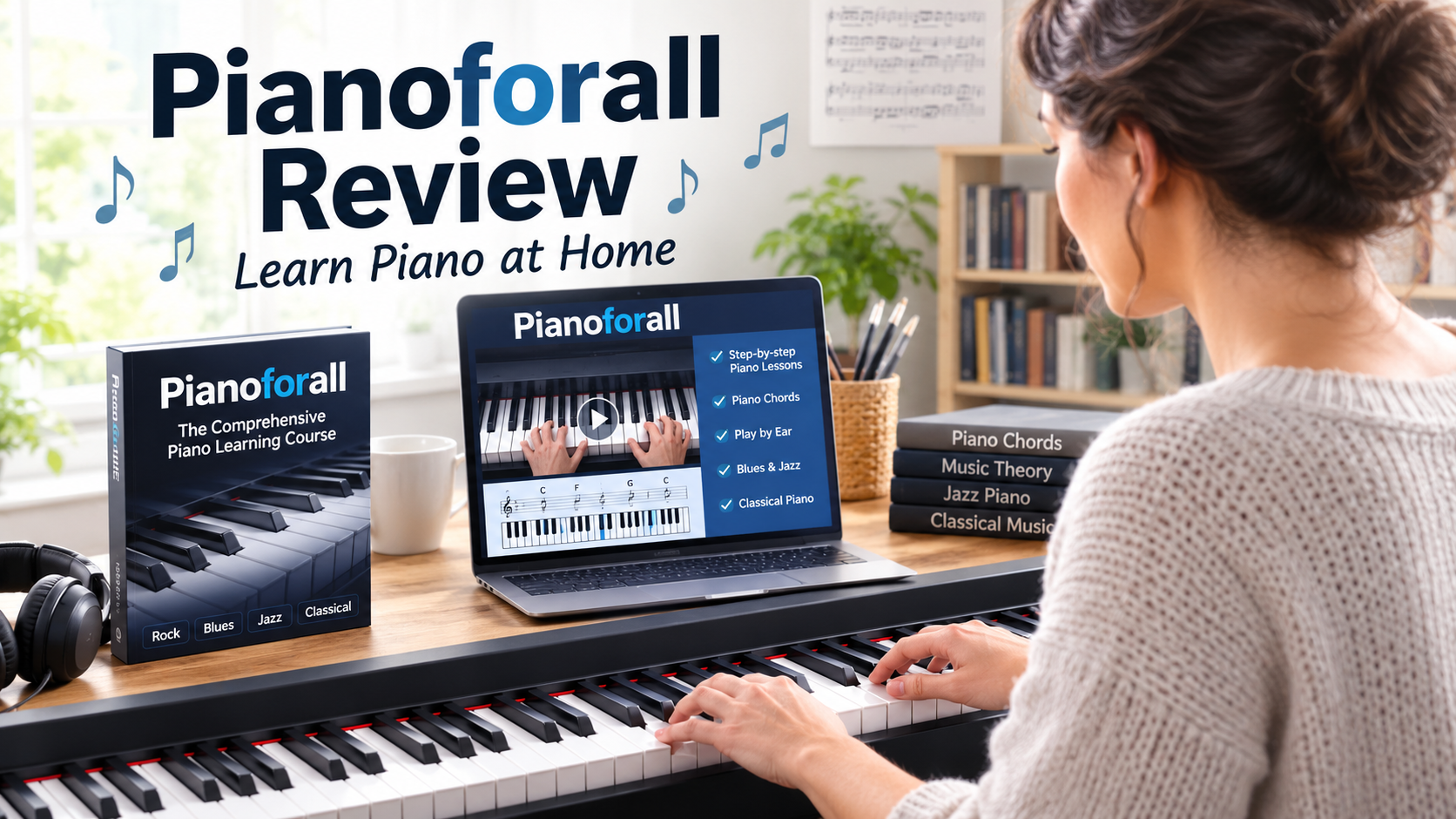
Learning to play the piano is one of those hobbies many of us would love to master, but traditional lessons can require a considerable commitment of both time and money. If you want to learn piano from home and progress at your own pace, an online piano course can offer an appealing alternative.
That’s where PianoforAll, sometimes searched for as Piano for All, comes in.
Pianoforall is a comprehensive digital piano course designed to take complete beginners through a structured series of lessons covering rhythm piano, chords, ballads, blues, jazz, improvisation, reading music and even classical piano.
According to the official Pianoforall website, the course has been used by more than 500,000 students worldwide and takes a practical approach that aims to get beginners actually playing the piano early in the learning process.
While I haven’t personally completed Pianoforall, I’ve reviewed the official course information in detail. Based on its published features, it looks like an impressively comprehensive option for anyone who wants to learn piano online without immediately committing to traditional weekly lessons.
👉 Visit Piano for All to find out more about learning piano online!
What Is Pianoforall?
Pianoforall is a self-paced online piano course combining interactive ebooks with audio demonstrations, video instruction, keyboard diagrams, musical notation and written lessons.
Rather than beginning with lengthy music-reading exercises, Pianoforall starts with what it describes as “Rhythm Style” piano. Students learn recognisable rhythms, chord progressions and patterns before gradually moving into more advanced areas of playing.
The course then expands into subjects including:
- Piano and keyboard chords
- Chord inversions
- Ballad-style piano
- Blues and rock ‘n’ roll
- Advanced chords
- Improvisation
- Jazz piano
- Advanced blues piano
- Reading sheet music
- Classical piano
- Scales and arpeggios
- Music theory
It’s an interesting approach because the emphasis is on making music early while gradually developing the theory and technical knowledge behind it.
Why Does Pianoforall Stand Out?
Learn Piano by Actually Playing
One of the most appealing aspects of the Pianoforall method is its emphasis on getting your hands onto the keyboard.
Traditional piano education can sometimes make beginners feel as though they need to spend months studying notation before they can properly enjoy their instrument.
Pianoforall takes a different route.
The course starts with popular rhythm-style piano and introduces 15 recognisable rhythms alongside chord progressions, ballads and playing formulas. The idea is to give beginners useful musical building blocks that can be applied to many different songs.
For hobby musicians in particular, that’s an attractive proposition. After all, most people decide to learn piano because they ultimately want to play music.
Learn Piano Chords and Progressions
Understanding Piano Chords
Piano chords are a major part of the Pianoforall system.
Students learn basic chords before progressing into chord inversions and more advanced chord structures. The course also includes a piano chord chart and exercises designed to help students move between chords more efficiently.
This can be particularly valuable if your ultimate goal is to accompany singers, play popular songs, write music or simply sit down at a keyboard and play for enjoyment.
Progress Beyond Basic Chords
Pianoforall doesn’t stop once you’ve memorised a handful of major and minor chords.
The course introduces more advanced chords through practical progressions inspired by popular styles of piano music, helping students understand how different chords work together musically.
That practical approach is one of the features I find most interesting about the course on paper.
Learn to Play Piano by Ear
Another major part of Pianoforall is learning to play piano by ear.
Instead of making music reading the prerequisite for playing, Pianoforall initially teaches students to recognise patterns, chord shapes and sounds.
The course uses what it calls a “Visual Association” approach. The idea is that students develop familiarity with the keyboard and music itself before gradually becoming more comfortable with written notation.
This could be especially attractive to people who have previously tried piano but found traditional sight-reading exercises discouraging.
Learn to Read Piano Music Too
Importantly, Pianoforall isn’t simply a “forget sheet music and play everything by ear” system.
Reading music is introduced as the course progresses.
The distinction is that Pianoforall aims to teach students to read piano music while also learning to play by ear.
That combination could ultimately produce a more versatile hobby pianist: someone who can work from written music but who also understands chords, patterns and improvisation.
👉 Visit Piano for All to find out more about learning piano online!
Explore Different Styles of Piano
One of the strongest aspects of Pianoforall is the variety of musical styles covered.
Rhythm Piano
The course begins with rhythm-style playing, providing patterns and progressions that can be applied across many popular songs.
Blues and Rock ‘n’ Roll Piano
Students progress into classic blues and rock ‘n’ roll rhythms, riffs and patterns.
This introduces a completely different character of piano playing and helps demonstrate how reusable musical patterns can appear across many songs.
Ballad-Style Piano
The ballad section introduces a more expressive playing style and encourages students to start improvising and creating melodies of their own.
Learn Jazz Piano
If you’ve always wanted to learn jazz piano, Pianoforall introduces jazzy chords, runs, riffs, patterns and blues scales.
There’s also advanced blues material for students who want to take their improvisation and blues playing further.
Learn Classical Piano
Later in the programme, students can move towards classical music.
The course uses the reading and playing skills developed during earlier lessons to introduce classical pieces associated with composers including Beethoven, Bach, Chopin, Mozart, Strauss and Brahms.
That journey from popular rhythm piano through to classical music demonstrates just how broad the Pianoforall curriculum aims to be.
Interactive Ebooks, Video and Audio Lessons
One of the biggest differences between Pianoforall and an ordinary piano instruction book is its multimedia approach.
The course combines:
- Written explanations
- Keyboard diagrams
- Musical notation
- Audio demonstrations
- Video lessons
- Visual keyboard aids
This should be particularly helpful for visual and auditory learners.
Instead of reading an explanation and wondering what a particular rhythm is supposed to sound like, students can hear and see examples alongside the written material.
Learn Piano on Different Devices
Another advantage for anyone learning as a hobby is flexibility.
According to Pianoforall, its interactive ebooks can be used across PC, Mac, Android, iOS, tablets and phones. The course materials can also be used without remaining online.
That makes it possible to put a tablet or laptop beside your piano or keyboard and work directly through each lesson.
For people trying to fit a piano hobby around work, family and other commitments, this flexibility is particularly useful.
Pianoforall for Complete Beginners
Pianoforall is specifically designed to take complete beginners towards an intermediate level.
You don’t need to arrive already knowing how to read sheet music or understand complicated music theory.
Instead, the course gradually introduces concepts as your practical playing develops.
This makes Pianoforall particularly interesting for adults who have always wanted to learn piano but assumed they had missed their opportunity.
There’s no age at which you suddenly become too old to enjoy making music.
Pianoforall for Existing Musicians
The course isn’t exclusively aimed at absolute beginners.
Existing musicians may find the chord, improvisation and play-by-ear elements particularly useful.
For example, a guitarist who already understands chord progressions but has never become comfortable with a keyboard may be able to transfer some existing musical knowledge to the piano.
The official website also specifically positions the programme as useful for songwriters and people who already play another instrument.
👉 Visit Piano for All to find out more about learning piano online!
Learn the Music Theory Behind What You’re Playing
While Pianoforall emphasises practical playing, it doesn’t completely avoid music theory.
Instead, the course aims to explain the “why” behind the music.
Students learn about chord structures, musical patterns and theory that can then be applied to other songs and original compositions.
I think this is an important distinction.
Memorising one song can teach you to play one song. Understanding why its chords and melodies work can potentially give you knowledge that transfers to hundreds of future pieces.
Improvisation and Creating Your Own Music
For creative musicians, one of the most exciting parts of learning piano is reaching the stage where you’re no longer simply reproducing somebody else’s music.
Pianoforall incorporates improvisation and melody creation into its curriculum.
As students develop their understanding of chords, scales and musical patterns, they’re encouraged to experiment and create.
This could make the programme particularly attractive to budding songwriters.
Scales, Arpeggios and Technique
Eventually, every serious piano student needs to develop some technical foundations.
Pianoforall includes scales and arpeggio exercises across different keys, but attempts to make these exercises more engaging through memory techniques and practical exercises.
This helps bridge the gap between playing for fun and developing stronger overall musicianship.
One-Time Payment Rather Than a Subscription
One appealing feature of Pianoforall is its payment model.
According to the official website, access is sold for a one-time payment rather than an ongoing monthly subscription.
For someone who wants to learn piano gradually over a long period, that can be attractive because you aren’t under pressure to complete lessons simply because another monthly payment is approaching.
The official website currently also advertises a 60-day money-back guarantee.
As pricing and purchase terms can change, it’s sensible to check the current offer directly before buying.
Student Support
Self-paced learning has plenty of advantages, but one potential drawback is not having a teacher sitting beside you when you get stuck.
Pianoforall says students can contact its instructors with questions and receive personalised responses.
That’s a useful addition because it provides some human support alongside the self-directed course materials.
What Are the Main Advantages of Pianoforall?
Based on the published course information, there is plenty to like.
Beginner-Friendly Approach
The programme starts with practical rhythm piano rather than overwhelming newcomers with advanced notation and theory.
Broad Range of Musical Styles
Students can explore rhythm, pop-style progressions, ballads, blues, rock ‘n’ roll, jazz and classical piano.
Play by Ear and Read Music
Rather than forcing students to choose between the two approaches, Pianoforall aims to develop both abilities.
Multimedia Piano Lessons
Video, audio, diagrams, written instruction and notation provide several different ways to understand each concept.
Self-Paced Learning
You can practise whenever you have spare time rather than arranging your life around a fixed weekly lesson.
One-Time Purchase
The absence of a recurring subscription could make Pianoforall attractive to hobbyists who want long-term access to their learning materials.
Are There Any Downsides?
No learning method is going to be perfect for everybody.
Pianoforall is primarily a self-directed course, so you’ll need enough motivation to practise regularly without a teacher physically sitting beside you.
Students seeking advanced classical training or formal examination preparation may also eventually benefit from personalised tuition from a qualified piano teacher.
And while the official site makes enthusiastic claims about how quickly students can begin developing useful piano skills, individual progress will naturally vary. How quickly you improve depends on your previous musical experience, practice frequency and personal learning style.
Who Is Pianoforall Best For?
Pianoforall looks particularly well suited to:
- Complete piano beginners
- Adults returning to music
- People who want to learn piano at home
- Self-directed learners
- Visual and auditory learners
- Guitarists and other musicians learning keyboard
- Songwriters
- People interested in playing piano by ear
- Learners who want to understand piano chords
- Hobbyists interested in blues, jazz and classical piano
The sheer breadth of the curriculum means there appears to be plenty to explore even after you’ve mastered the introductory material.
Is Learning Piano a Good Hobby?
Absolutely.
Playing piano combines creativity, coordination, concentration and continuous learning. It’s also a hobby you can enjoy almost anywhere with access to a piano or digital keyboard.
Perhaps most importantly, there’s always somewhere new to go.
You might start by learning a few basic chords, move into accompanying your favourite songs, discover blues improvisation and eventually find yourself tackling classical music.
A structured course such as Pianoforall can provide a roadmap through that journey.
Final Verdict: Is Pianoforall Worth It?
Based on the current published information, Pianoforall looks like a particularly comprehensive option for people who want to learn piano online in an enjoyable, practical and structured way.
What stands out most is the progression. Rather than making beginners spend a long period studying theory before enjoying the keyboard, Pianoforall starts with rhythm, patterns and piano chords, then gradually expands into ballads, blues, improvisation, jazz, reading music, classical piano, scales and deeper music theory.
The combination of interactive ebooks, video, audio and visual keyboard instruction also gives it considerably more depth than a conventional beginner piano book.
I haven’t personally completed the Pianoforall programme, so this assessment is based on the course’s current published features rather than first-hand results. However, for someone who wants to learn piano, develop the ability to play piano by ear, understand chords and eventually explore everything from jazz piano to classical piano, Pianoforall presents a compelling and unusually broad learning package.
If your goal is to turn playing piano into a rewarding long-term hobby without immediately committing to expensive recurring lessons, Piano for All certainly looks worthy of consideration.
👉 Visit Piano for All to find out more about learning piano online!
Leave a Reply
You must be logged in to post a comment.